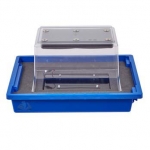
Formation of Sodium Ion Model
.png)
Product Code : SCL-AS-12489
The Formation of Sodium Ion Model is a chemistry teaching aid used for demonstrating how a neutral sodium atom loses one electron to form a positively charged sodium ion, Na+. Designed for chemistry teachers, school students, science laboratories, and STEM classrooms, it helps make valence electrons, cation formation, electron loss, and ionic bonding easier to explain visually.
Product Description
The Formation of Sodium Ion Model represents the fundamental process by which a sodium atom becomes a sodium ion. Sodium has atomic number 11 and one electron in its outermost shell. When that electron is lost, the atom forms Na+, a cation carrying a single positive charge.
This educational model supports lessons on atomic structure, electron configuration, valence electrons, cations, ion formation, and ionic compounds. It can complement other resources in the Materials & Their Properties collection. Product material, dimensions, weight, and exact physical configuration were not supplied and are therefore not claimed.
Key Features
- Visualizes electron loss: Helps demonstrate how a sodium atom loses its single outer-shell electron.
- Explains Na+ formation: Shows the conceptual change from neutral sodium to a positively charged sodium ion.
- Supports valence-electron learning: Reinforces the role of sodium's one outer-shell electron in ion formation.
- Clarifies cation formation: Helps students understand why losing an electron produces a positive ion.
- Supports ionic-bonding lessons: Provides a foundation for explaining how Na+ participates in ionic compounds.
- Suitable for classroom demonstrations: Useful for teacher-led instruction and supervised student learning.
- Makes abstract chemistry visible: Supports clearer discussion of an atomic-scale process through physical representation.
Technical Specifications
|
Specification |
Detail |
|
Product Name |
Formation of Sodium Ion Model |
|
Brand |
School Equipments |
|
Product Type |
Chemistry teaching model |
|
Subject Area |
Ion formation, atomic structure, and ionic bonding |
|
Element Represented |
Sodium, symbol Na |
|
Atomic Number |
11 |
|
Valence Electrons in Neutral Sodium |
1 |
|
Ion Formed |
Sodium ion, Na+ |
What's Included in the Kit
- Formation of Sodium Ion Model
- Exact component quantity, construction material, accessories, and physical configuration were not supplied in the available product information.
Applications / Uses
- Demonstrating how a neutral sodium atom loses one electron to form Na+.
- Teaching the difference between a neutral atom and a positively charged ion.
- Explaining valence electrons and outer-shell electron arrangements.
- Introducing cations and their role in ionic compounds.
- Supporting lessons on electron transfer and ionic bonding.
- Connecting sodium-ion formation with chemical formula writing and charge balance.
How to Use the Formation of Sodium Ion Model
- Identify the representation of the neutral sodium atom.
- Explain that sodium has atomic number 11 and one electron in its outermost shell.
- Locate the representation of the outer valence electron.
- Demonstrate the loss of this one electron from the sodium atom.
- Explain that the resulting species has one fewer electron than protons and therefore carries a positive charge.
- Identify the resulting sodium ion as Na+.
- Extend the lesson using the Formula Finder Kit for ionic compound ratios and the Structure and Bonding Kit for broader atomic-structure and bonding concepts.
Safety and handling note: Use the model under appropriate classroom supervision. Handle all components carefully and follow any product-specific instructions supplied with the product.
Care & Maintenance
- Store the model in a clean, dry location after classroom use.
- Handle individual components carefully to prevent physical damage or loss.
- Use a soft, dry cloth for routine cleaning unless different manufacturer instructions are provided.
- Avoid solvents and abrasive cleaners unless compatibility with the construction material has been confirmed.
Why Choose School Equipments
School Equipments is based in Ambala, India, and manufactures and supplies science education instruments and school laboratory equipment. Its range includes chemistry instruments, scientific laboratory equipment, science teaching aids, mathematics resources, and related educational products. The company states that it has accumulated business experience with schools and companies across more than 20 countries and regions. This manufacturing and international supply background supports institutional, distributor, and educational procurement requirements.
Frequently Asked Questions
What is the Formation of Sodium Ion Model used for?
It is used to demonstrate how a neutral sodium atom loses one electron and forms a positively charged sodium ion, Na+.
How does a sodium atom form a sodium ion?
A sodium atom has one electron in its outermost shell. When it loses that electron, it forms Na+, a cation with a single positive charge.
Why does the sodium ion have a positive charge?
After losing one electron, the sodium ion has one more proton than electrons. This imbalance gives it an overall charge of +1.
Can this model be used to teach ionic bonding?
Yes. It provides a foundation for explaining electron transfer and how positively charged sodium ions combine with negatively charged ions in ionic compounds.
Is the Formation of Sodium Ion Model suitable for schools?
Yes. It is suitable as a visual teaching aid for supervised lessons on atomic structure, valence electrons, cation formation, electron transfer, and ionic bonding.
What material is the Formation of Sodium Ion Model made from?
The construction material was not supplied in the available product information, so no specific material is claimed.
Explore the complete chemistry teaching equipment range from School Equipments for related chemistry models, classroom teaching aids, and laboratory resources.
.jpg)
.jpg)

 (1).png)
.jpg)
.jpg)