
Covalent Bond in Water Model
.png)
Product Code : SCL-AS-12498
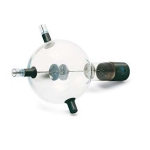
The Covalent Bond in Water Model is a chemistry teaching aid used for demonstrating how one oxygen atom forms covalent bonds with two hydrogen atoms in an H2O molecule. Designed for chemistry teachers, school students, science laboratories, and STEM classrooms, it helps learners visualize electron sharing, O–H bonds, molecular composition, and polar covalent bonding.
Product Description
The Covalent Bond in Water Model represents the fundamental bonding arrangement within a water molecule. Water has the chemical formula H2O, meaning each molecule contains one oxygen atom and two hydrogen atoms. Oxygen shares one pair of valence electrons with each hydrogen atom, forming two O–H covalent bonds.
The model supports lessons on atoms, molecules, valence electrons, electron sharing, Lewis structures, covalent bonding, molecular polarity, and chemical formulas. It can complement related resources in the Materials & Their Properties collection. Construction material, dimensions, weight, and exact physical configuration were not supplied and are therefore not claimed.
Key Features
- Represents the H2O molecule: Helps students identify one oxygen atom bonded to two hydrogen atoms.
- Shows two O–H covalent bonds: Supports clear explanation of the bonding arrangement within one water molecule.
- Explains electron sharing: Demonstrates that oxygen shares one electron pair with each hydrogen atom.
- Supports valence-electron lessons: Helps connect oxygen's six valence electrons and hydrogen's one valence electron with bond formation.
- Introduces polar covalent bonding: Supports discussion of unequal electron sharing in O–H bonds.
- Clarifies molecular formulas: Connects the formula H2O with a molecular composition of two hydrogen atoms and one oxygen atom.
- Suitable for classroom demonstrations: Useful for teacher-led instruction, revision, and supervised student discussion.
Technical Specifications
|
Specification |
Detail |
|
Product Name |
Covalent Bond in Water Model |
|
Brand |
School Equipments |
|
Product Type |
Molecular structure and chemical bonding teaching model |
|
Molecule Represented |
Water, H2O |
|
Atomic Composition |
2 hydrogen atoms and 1 oxygen atom |
|
Covalent Bonds Represented |
2 O–H bonds |
|
Bond Type |
Polar covalent |
|
Primary Teaching Concepts |
Electron sharing, valence electrons, covalent bonding, molecular structure, and polarity |
What's Included in the Kit
- Covalent Bond in Water Model
No additional components or accessories are claimed because an exact supplied component list was not available.
Applications / Uses
- Demonstrating the molecular composition of water.
- Teaching how two O–H covalent bonds form within H2O.
- Explaining electron sharing between oxygen and hydrogen atoms.
- Introducing polar covalent bonds and unequal electron sharing.
- Supporting lessons on Lewis structures and valence electrons.
- Distinguishing intramolecular covalent bonds from intermolecular hydrogen bonding.
How to Use the Covalent Bond in Water Model
- Identify the central oxygen atom and the two hydrogen atoms represented by the model.
- Explain that oxygen has six valence electrons, while each hydrogen atom has one valence electron.
- Show how oxygen shares one electron pair with the first hydrogen atom to create one O–H covalent bond.
- Repeat the explanation for the second hydrogen atom to demonstrate the second O–H bond.
- Relate the three represented atoms to the chemical formula H2O.
- Explain that oxygen attracts the shared bonding electrons more strongly than hydrogen, making each O–H bond polar covalent.
- Extend the lesson with the Structure and Bonding Kit for broader study of atoms, orbitals, ions, isotopes, and bonding.
- Use the Formula Finder Kit to reinforce chemical formulas and element ratios.
Safety and handling note: Use the model under appropriate classroom supervision. Handle all components carefully and follow any product-specific instructions supplied with the product.
Care & Maintenance
- Store the model in a clean, dry place after classroom use.
- Handle all parts carefully to reduce the risk of physical damage or loss.
- Use a soft, dry cloth for routine cleaning unless different manufacturer instructions are supplied.
- Avoid solvents and abrasive cleaners unless compatibility with the construction material has been confirmed.
Why Choose School Equipments
School Equipments is a manufacturer and exporter of scientific laboratory instruments, laboratory experiment setups, science kits, mathematics kits, didactic models, and STEM models and kits. Its educational equipment range serves schools, colleges, science laboratories, distributors, and institutional buyers. The company states that it has accumulated business experience with schools and companies across more than 20 countries and areas. Its broad educational product portfolio supports classroom demonstrations, laboratory activities, and international procurement requirements.
Frequently Asked Questions
What is the Covalent Bond in Water Model used for?
It is used to demonstrate how one oxygen atom shares electron pairs with two hydrogen atoms to form an H2O molecule containing two O–H covalent bonds.
How many covalent bonds are present in one water molecule?
One water molecule contains two O–H covalent bonds. The oxygen atom shares one pair of electrons with each hydrogen atom.
Are the O–H bonds in water polar or nonpolar?
The O–H bonds are polar covalent because oxygen attracts the shared bonding electrons more strongly than hydrogen.
What atoms are present in an H?O molecule?
Each H2O molecule contains two hydrogen atoms and one oxygen atom.
Is a covalent bond in water the same as a hydrogen bond?
No. O–H covalent bonds hold the oxygen and hydrogen atoms together within an individual water molecule. Hydrogen bonds are intermolecular attractions that can occur between separate water molecules.
Can this model be used in school chemistry classes?
Yes. It is suitable as a visual teaching aid for supervised lessons on atoms, molecules, electron sharing, valence electrons, covalent bonds, polarity, and chemical formulas.
Explore the complete chemistry teaching equipment range from School Equipments for related molecular models, chemistry teaching aids, classroom demonstration equipment, and laboratory resources.
-Photoroom (1).png)

.png)
 (1).png)
.jpg)
.jpg)